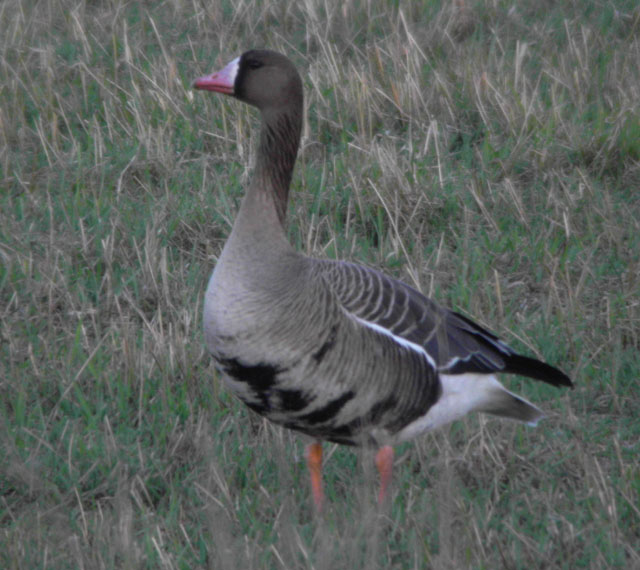
Ornio tour in “Southern” Finland with a British group
The trip begins
On the 23rd of May I started my way to Tampere at 6:00 a.m. and I drove straight until Hervanta where I left my car to a garage and then took a taxi to Pirkkala airport. After some waiting the British group, that I was about to guide for the next 8 days around “Southern” Finland, came with their luggage and after they had got their rental Opel Astra, we were ready to go.
The group was Sean Minns, who had contacted Hanna and then gathered a group from BirdForum users, David Bruce, Dave Bywater and Robert Ulph. The age of the group was from 39 to 64 years.
The weather was very bad, windy and rainy, so we after some shopping we started to drive straight to Oulu.
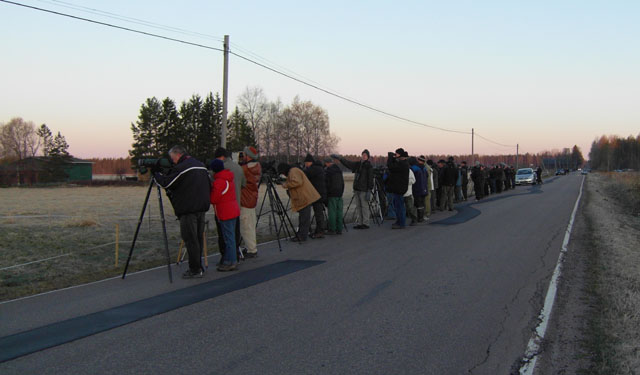
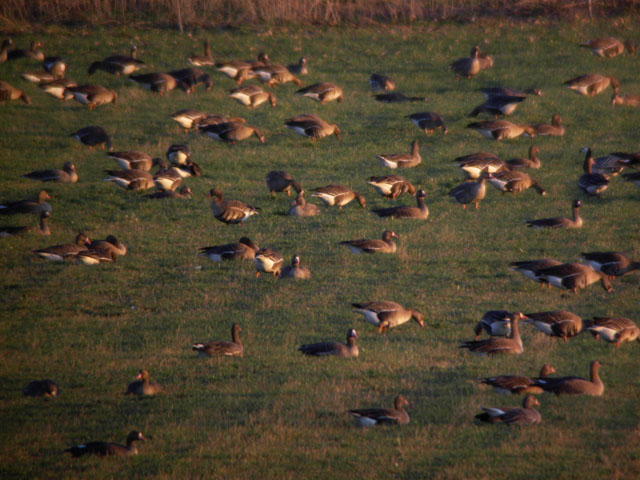
On the way we didn’t really see many birds: of course some Whooper Swans, Cranes and Black-throated Divers and so on, but the first stop was made only when it was necessary. So we stopped in Kärsämäki just for a leak, but it was a good stop as there was a Hazel Hen singing on the closest trees. I used my mp3-player and soon the Hazel Hen flew over us and landed to a tree where we could see it pretty well! It was already getting late so we hadn’t got any serious plans for the day except to get to Liminka. So we decided to try to twitch a Whiskered Tern in Utajärvi Ahmasjärvi as it would have been a Finnish lifer for me. But unfortunately the bird had disappeared once we got there. Anyway we saw some birds like a flock of Bean Geese and of course many birders that had also came there too late. Soon we continued to Oulu.
In Oulu we drove to Terek Sandpiper places where we met my old friend Antti Vierimaa who gave us a key to old information centre of Liminkabay. Antti was working as a guide in Virkkula, so he helped us to get a roof over us as the weather was still very bad. After some waiting the Terek Sandpiper started to call and soon we found it perched on a small hill. What a good bird! This species is so rare nowadays that you never know when it is the last time you see it! Soon we continued to Liminka where we went straight to sleep to the floor of the information centre. Of course we all had good mattresses and sleeping bags as the group had wanted to camp during the trip and so keep the costs down.
On the 24th of May part of the group had awaken early and they had seen some good birds like a Peregrine, Short-eared Owls, Common Rosefinch, Bluethroat, Bean Goose and so on. Luckily most of the species were found again with the rest of us too. A couple of Barnacle Geese, Black-tailed Godwits, 4 White-tailed Eagles, a Garganey, 2 Smews and so on were also seen before we continued our way.
On the way to Oulunsalo we found the first singing Ortolan Bunting and in Letto we tried to find a Hawk Owl that had been seen on the previous morning. But the wind was still extremely strong so it wasn’t a surprise that only a Sparrowhawk and a Common Rosefinch were found. In midday we met Pentti Hukkanen in Oulu and we continued with him to Kiiminki to see owls! Pentti is an old friend of my parents so he is always happy to help me with the owls that he and his son Markku really love!
On the way we saw a male Hen Harrier and surprisingly already our first Reindeers! After some walk in a deep spruce-forest we found the nest that we were looking for – a stunning Great Grey Owl female was looking at us from the nest! It was one of the main target-species of the trip!


After some time Pentti asked me to use mp3-player if the male would come to visible too and I carefully played a couple of tunes of a Great Grey Owl, first nothing happened, but then we noticed a raptor flying right over us – a male Pallid Harrier had came to see the owl! Amazing! And this wasn’t yet enough; soon we noticed that a male Great Grey Owl was also perched just on one of the closest trees! So after some photographing we were happy to leave these owls and walked back to the cars.
Then we walked some hundreds of metres to another direction where we checked a hole in the tree where a Pygmy Owl was breeding, but it was impossible to see to the nest and the male wasn’t found – we only heard female calling from the nest. So we had to continue to another nest of Pygmy Owl.
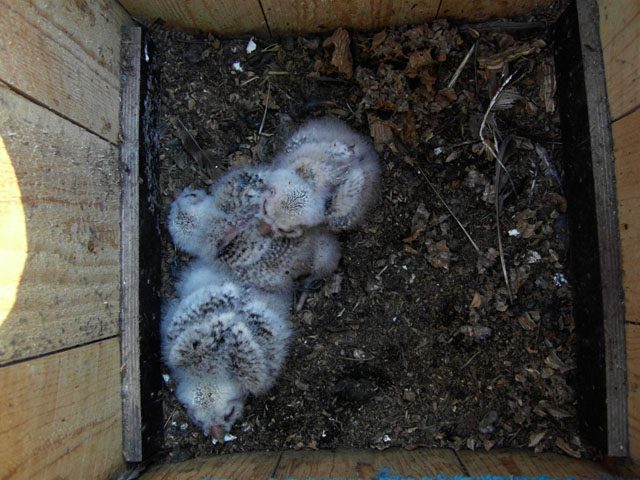
On the way we saw a Pheasant and checked one old Eagle Owl nest which unfortunately was empty this year but soon we were walking in a forest again. Now we had a Pygmy Owl nest-box and there was a female with 5 nestlings and still 2 eggs.
Soon we said thanks and goodbyes to Pentti and continued towards Kuusamo. We had planned to visit Ahmasjärvi and Whiskered Tern again as it had been again in the lake whole day but unfortunately soon it disappeared again so (luckily) we could stay on the main road on keep on driving. We stopped shortly in Ylikiiminki Hirvisuo where only a female Hen Harrier was seen before continued to Taivalkoski Lampilehto where a ringer I didn’t know had reported a family of Hawk Owls on the previous day. It was a long way but luckily we managed to find the right place with help of a GPS I had. The weather was still very windy but soon we found the first adult Hawk Owl and soon also another one and after some waiting we started to hear calls of youngsters too.


So we photographed these amazing birds and while we were photographing youngsters the adults were carrying food for the other youngsters. We found 3 youngsters from the trees and one was still in the nest-hole high on the tree. What amazing birds! But it was already getting late so we had to continue towards Kuusamo.
Kuusamo
On the way we still saw an Elk and more Reindeers and in Kuusamo Ruka we found a couple of Willow Grouses along the road! It was already very late and it was again raining but still I decided that we should overnight in Valtavaara. On of us decided to sleep in a car but the rest of us climbed up to Valtavaara and camped there. Luckily it wasn’t raining too heavily so we managed to go to sleep dry. Even though the climbing was a little bit too hard, I was sure it was the right place to wake up next morning!

25th of May. The night was very wet but luckily it wasn’t raining at all when we woke up. And why we woke up – a Red-flanked Bluetail was singing just above our tent! Unfortunately the bird was very mobile and it stopped singing soon, so we didn’t manage to see it at all. With Sean and Dave we packed our tents soon while Rob decided to sleep a little bit more. David was up also when we were back in Konttainen parking place. He had managed to see Willow Grouses just in front of the car earlier. Soon we found a family of Siberian Jays and some Parrot Crossbills were heard too. I climbed back up to Valtavaara to help Rob with his packing. When we were again down Sean and Dave had seen a female Capercaillie and Dave and David had seen a Pygmy Owl! We still continued birding around the hills as the group had different interests and different styles of birding and we found a couple of more families of Siberian Jays, 3 Red-flanked Bluetails, but only David managed to see one female well, a Red-throated Diver flew over us and other birds were a Wren, a Chiffchaff, a Dunnock, Bullfinches, singing Hazel Hens and so on.

After some hours birding in Valtavaara and Konttainen we continued to Vuotunki bird-tower which is a good place for buntings and also many other birds. We found 23 Velvet Scoters which one of them looked amazingly just like a Steller’s Eider until it finally woke up and showed its wings! A Lesser Spotted Woodpecker and an Osprey were seen and a Rustic Bunting heard “ticking” but then it started to rain very heavily, so we decided to continue towards Oulanka National Park.
On the way to Oulanka we saw a Dipper and in Oulanka we first walked to Kiutaköngäs rapid where a Grey Wagtail was heard once. Then we spent an hour in forest where we after some searching found beautiful Calypso Orchids. Sean saw a Ural Owl briefly but it wasn’t found again. A couple of Crested Tits were also heard before we continued back towards Kuusamo city.
In Ruka we saw a Waxwing perched on the top of a spruce and then we continued to a traditional area to search a nest-box of a Siberian Tit. We had met Pentti’s son Markku who was leading a Finnature group and he had his own Siberian Tit studies in Kuusamo so he could give us notes how to find the right nest-boxes and after some searching we finally found one where was a female Siberian Tit still incubating its eggs. We left the Siberian Tit soon and found a stunning Black Woodpecker while walking back to our car
In the evening we still checked Kuusamo rubbish tip where we found lots of Lesser Black-backed Gulls, 6 Heuglin’s Gulls, a Great Black-backed Gull, a Temminck’s Stint and a young White-tailed Eagle flew over us.


In Säynäjäperä we stopped to check a traditional Little Bunting place and surprisingly saw a Tengmalm’s Owl flying to one of the Smew nest-boxes with a prey – it was breeding there! Also a Marsh Harrier and some Red-necked Grebes were seen.
It was again very late when we were heading to our camping place to Iivaara. On the way we saw 2 male Black Grouses but finally we were in Iivaara parking place where we made a camp to the forest and started to sleep.
26th of May. Some of the group had again awaken earlier and already seen and heard a Rustic Bunting on the Rajalampi river but luckily the bird stayed active and we all managed to see it well.
Soon we started to walk towards Iivaara hill. The forests were surprisingly quiet, only several big flocks of Common Crossbills with some odd Parrot Crossbill were heard. I was the first one to reach the top of Iivaara while the rest were resting a little bit lower along the track. And almost the first birds I found were a male and a female Two-barred Crossbill!


I whistled and shouted and luckily Rob managed to hear me and ran to see the birds and while Rob stayed there I went to find the rest of the group. Luckily the birds stayed there long enough that we all managed to see them well.
Later we found also the fledlings of Two-barred Crossbills and these sleepy birds let us photograph themselves from just some metres. While we were photographing them we heard a Pine Grosbeak singing and soon we were photographing a young male singing on the top of a spruce! What a visit to Iivaara again!


While we were walking back down to our camp a heavy hail-storm hit us! All but Rob managed to get tents and other stuff to a car before getting absolutely wet and luckily Rob had very good quality equipments so getting them wet didn’t really matter.
North Karelia
Then we had another long drive in front of us. We started do drive towards North Karelia and Lieksa Kitsi. The weather was again very rainy so we didn’t really have any opportunity to do any birding on the way. We did stop to watch a funny Silent people -artwork and of course did some shopping for the next 2 days as we knew there were no shops where we’re going.
Finally we parked to Loma-Kitsi where we had rooms in an old school building. From the garden we found a male Red-backed Shrike and a couple of Common Rosefinches before we had a good Elk-soup, good Finnish sauna and went to sleep.

On the 27th of May we woke up before 6 a.m. again. Just outside the building we found a couple of Wood Warblers, a Hazel Hen and a Blyth’s Reed Warbler which unfortunately left to continue its migration. Soon we were on our way to our next target Hemminvaara.
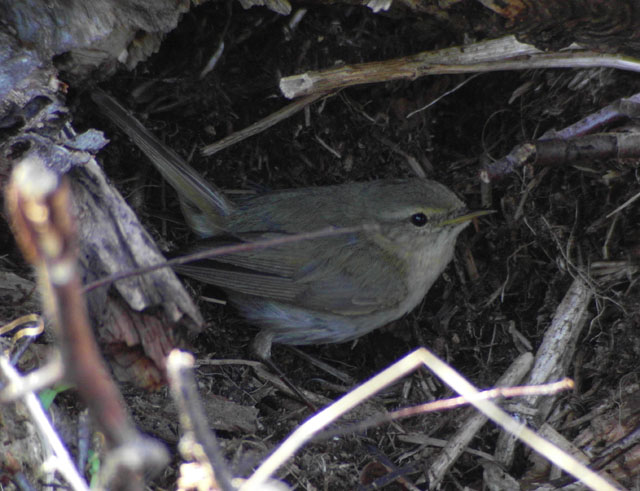
When we had parked our car and were taking all our equipments out, we already heard the first Greenish Warbler singing. This bird we also managed to attract closer to get photographed. We walked in the forests for a couple of hours and found 2 more Greenish Warblers, one more Red-flanked Bluetail that we didn’t manage to see, a nice singing adult male Red-breasted Flycatcher, several Three-toed Woodpeckers, a Honey Buzzard, a Goshawk, Wood Warbler and much more. So we got several important target species again!


Our next place was long Teretti path which lead to a bird-tower into the middle of big bogs, but as we didn’t have enough time we decided to walk just as far as we had time. Waders were surprisingly quiet so we heard only some Wood Sandpipers and Whimbrels, but some of us saw briefly an eagle flying low in a haze and disappearing soon – it might have been a Greater Spotted Eagle – for sure not a White-tailed Eagle but an Aquila. We also 3 Willow Grouses which one of them was defending its territory very aggressively! It was really attacking to us!

Its main targets were Rob’s shoes so we all managed to get good pictures and videos and of course good laugh before we let this poor bird to its territory. But soon we had to turn back, before we had reached to bird-tower, as we had to hurry to Erä-Eero where we were supposed to be at 3 p.m.
Erä-Eero hide
We were just in time in Erä-Eero cottage where we met Eero and another guide. After some coffee and Karelian pies we got information about the hide and how to act there. Eero luckily remembered me and it was ok that we didn’t need any other guide than me. So soon we drove to the hide following Eero who still had to come to hide all the meat for large beasts.
Just after 5 p.m. Eero left and we stayed in photographers hide and started to wait something to happen. First we practised our camera-settings with Common and Herring Gulls and a pair of Great Spotted Woodpeckers that were feeding with meat just in front of us.


But already before 7 p.m. a Wolverine came slowly visible to another side of the lake. It stopped to the shore and watched and sniffed to the air but soon it continued to a tree that lead over the river towards us! It came slowly closer and closer and finally started to search for food from the places it had used to find the meat that Eero had hidden. It didn’t take long when it found some meat and carried it back to where it had come from. But surprisingly it stopped under a spruce and started to eat the meat and after some time it came to get another piece of meat. Now it had to come even closer so we managed to get very good quality pictures of it!

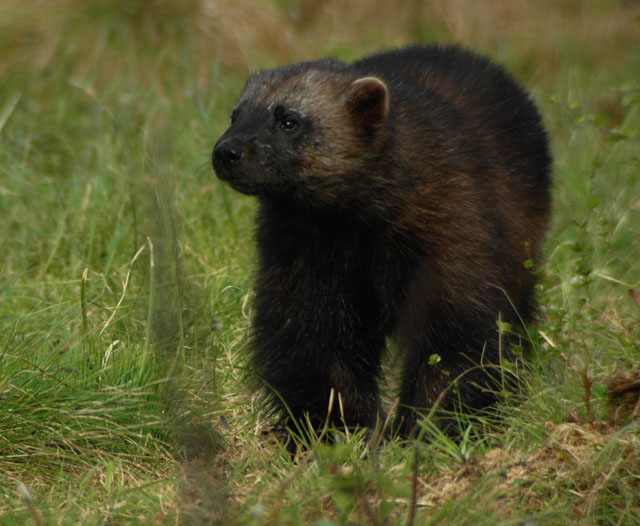
I had given very strict instruction how we should act in a hide but anyway we were maybe a little bit too noisy so Ravens never came to get their pieces of meat. Maybe that was the reason that Brown Bears didn’t come either. David maybe saw one Bear briefly but too far in the forest to make sure what it really was. We had to also wait for Wolverines for several hours before the first visit but finally at 11 p.m. a Wolverine came to get its meat. This Wolverine was much smaller than the first one but it was already too dark to get any pictures.

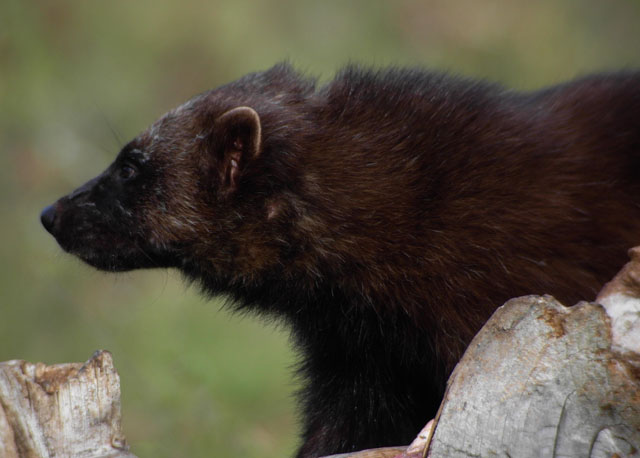
28th of May. At 1:00 a.m. another Wolverine came to search for food but after that it was very quiet for a long time. Every one of us slept for some time – some longer and me only a couple of hours. There was a good snoring in a hide so it wasn’t anymore possible to see any bears. But Wolverine came still once at 4:30 but after that I also went to sleep again. Sean had still seen a Wolverine once at 6 a.m. so altogether we had seen a Wolverine 6 times – we weren’t sure if there had been 2 or 3 animals.
The group had been sleeping so well that I decided to change the plans as I was maybe the only almost too tired to continue, so we drove to Autiovaara. We walked around this 3 kilometres long path and finally found a 2nd calendar year Red-flanked Bluetail that we managed to see well. We also found 3 Red-breasted Flycatchers, 2 Wrens, a Hazel Hen and so on.


After finishing a breakfast in a parking place, we had a long drive to Tohmajärvi Värtsilä Sääperi. It was raining again very heavily but when we reached Sääperi it stopped. So we continued straight to a Great Snipe place as I had got information that they had been lekking during the day too. We were just walking along the field-road when 3 Great Snipes flushed some 30 metres from us and flew just over us and continued to different directions. Right after this it started to rain again, which was probably a reason why the birds had left – they probably wanted to get somewhere under a willow to escape the heavy rain or something. We still heard a Thrush Nightingale and a Grasshopper Warbler singing but the heavy rain forced us back to the car. We had seen the Great Snipes much easier than I had expected and the heavy rain was causing that they weren’t coming back to lek very soon, so we decided to start driving towards Parikkala right away and save some time for the rest of the trip.
In Parikkala
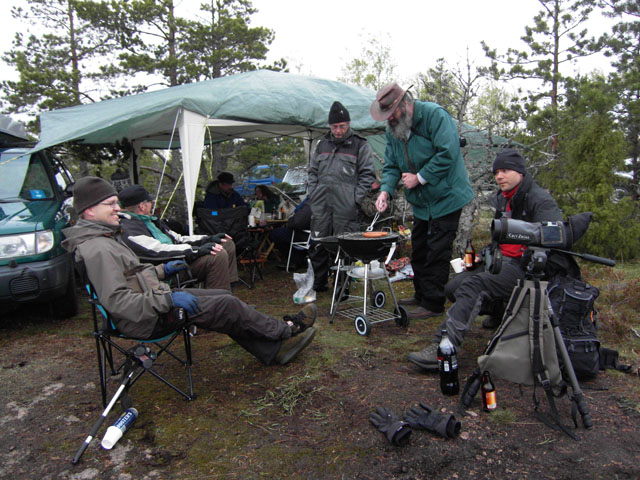
Our group started to be extremely tired so I made a decision and called to Hanna that she’d ask a cottage for the next 2 nights we still had left. None of the group looked like that they’d like to be in a tent any more nights. So Hanna arranged a big cottage, or maybe more like a villa, from Loikonsaari. We managed to keep the costs down as we didn’t take any bed-clothes or towels. The villa was the biggest and best in whole Parikkala and it is the one where Russian politicians are staying when they visit Parikkala on their holidays. So it’d have been much more expensive than it now was, but we have good contacts to the owner.
On the way to Parikkala David wasn’t too tired yet as he found a perched Ural Owl while we were driving 100km/h. The bird stayed there long enough that we all managed to see it, but not enough to stay photographable.
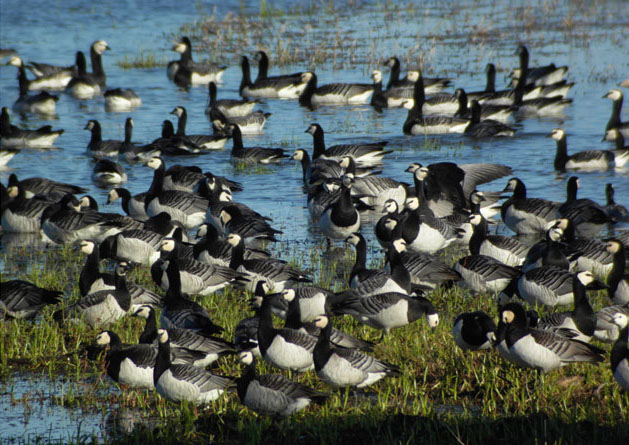
We also stopped in Parikkala Saari Akanvaara Tetrisuo where we saw 29 Black Grouses, 2 Ortolan Buntings and 2 female Hen Harriers and in Pohjanranta bird-tower where we saw a flock of Barnacle Geese before we continued to Loikonsaari.
The owner Matti Kähkönen still showed us some things in a villa and then I left the group there and drove to home to sleep.
29th of May. We were back in Loikonsaari with Hanna at 6 a.m. and the group was already ready (which surprised me  ! Soon we were on our way to Siikalahti, but on the way we stopped in Särkisalmi where we heard several Thrush Nightingales and Blyth’s Reed Warblers and a Marsh Warbler. In Siikalahti dam-road we heard a couple of Spotted Crakes and surprisingly we even saw one bird flying from a reedbed to another. Also a Bittern flew over us. A Canada Goose, Slavonian Grebes and Pochards were of course seen and Water Rails heard too.
Soon we continued towards Sammallampi which is always a good place to find the first Corn Crakes of the year and the first Corn Crake was heard in a couple of minutes. A Golden Oriole was also heard. Unfortunately we couldn’t see a Corn Crake so we continued towards Suurisuo where we found another one but it also came quiet when we tried mp3-player and even more quiet when we tried to flush it.
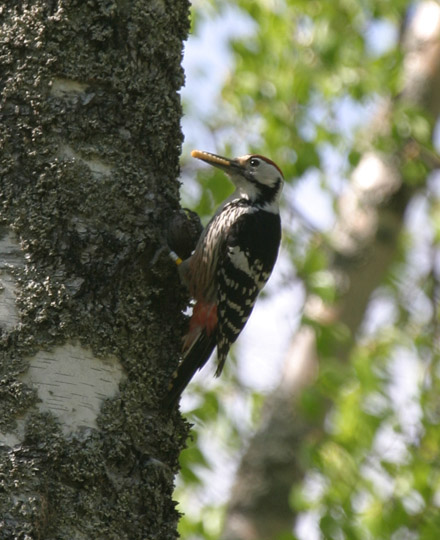
Next we continued to a nest of a White-backed Woodpecker that Hanna had found a day earlier. Big nestlings were begging food from a couple there! We also saw and heard a Grey-headed Woodpecker very briefly in same place.
Next we continued to a Tengmalm’s Owl nest-box from where we had already ringed 3 bigger nestlings but there had been still one more, too small nestling to ring. But now the sisters had eaten the smallest one so there was nothing to ring anymore. In Tyrjä we checked a Ural Owl nest-box where surprisingly was a female still incubating an egg! The nesting must have been destroyed for some reason as there had been 2 eggs a month earlier.
Then we all started to feel too tired to continue so we drove to Loikonsaari and arranged to meet there again at 4 p.m. I must say that during the morning we had heard 25 Blyth’s Reed Warblers and 7 Thrush Nightingales and of course we had managed to see some of them well.
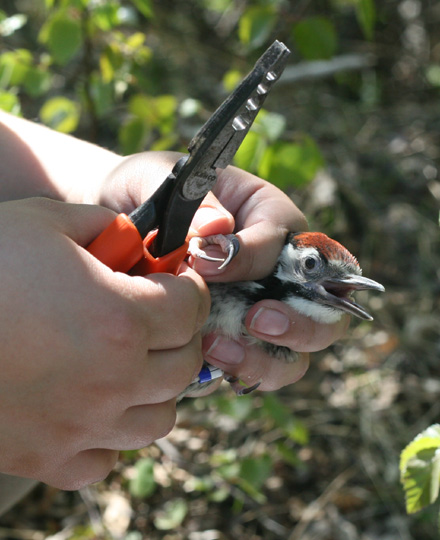
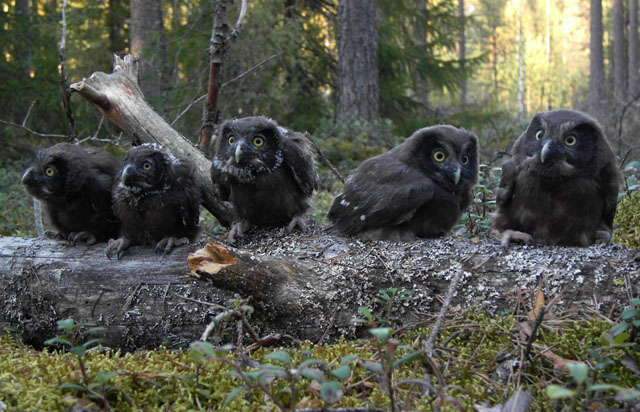
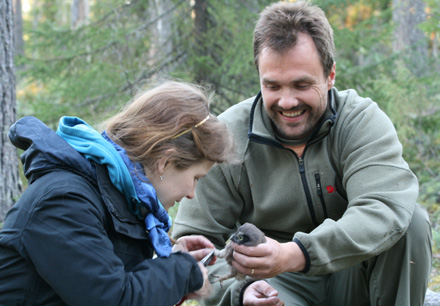
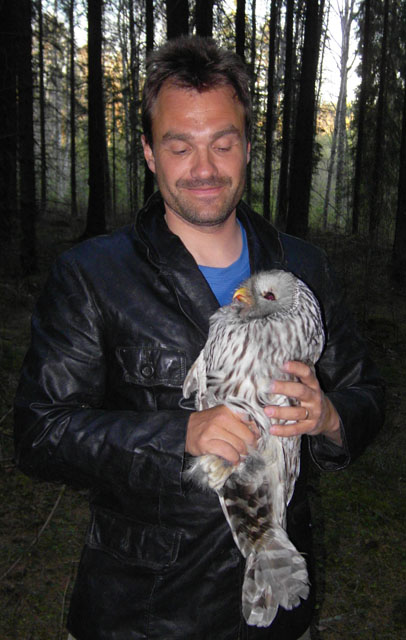
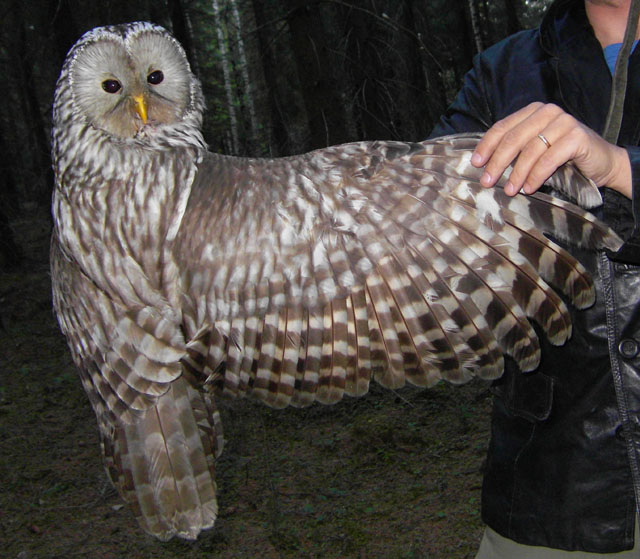
After some sleeping at 4 p.m. we were birding again. We headed again to Siikalahti where we had an Ortolan Bunting singing in a parking place and a Wryneck next to an information centre. But it was surprisingly quiet in a bird-tower. So soon we continued to ring some more Ural Owl nestlings. Our old crazy Ural Owl mama was as aggressive as always but I managed to get the nestlings to the car where we ringed them easily. I also managed to get the nestlings back to the nest-box easily but when I was closing the roof of the nest-box the mom-owl hit to my soft fireman-helmet very hard. Luckily we both were uninjured, but at least the group believed me as I had told that the most dangerous animal in Finland is a Ural Owl – not a Brown Bear! At least Ural Owl is the only animal I am afraid of…
In Rautalahti we counted 80 Whooper Swans and saw the first Long-eared Owl of the trip and also for the year. On the next Ural Owl nest the mom-owl was very shy so we hardly saw it at all. 2 nestlings were ringed but 2 were still too small to ring.
We still continued to Punkaharju to one small lake where a Red-throated Diver was again breeding. We didn’t go close at all as the breeding seemed not to be in the island it usually is. So maybe the nest was on the shore? So we just enjoyed good views of another adult swimming on the lake by telescope before we left back to Parikkala. We still twitched a pair of Long-tailed Tits that surprisingly was in the same place than a couple of months earlier when we had been checking the owl nest-boxes. After we had seen a couple of male Red-backed Shrikes we were ready go back to the villa. We warmed up the good wood-sauna for the group and left them to do packing and have sauna and sleep and drove to our home to sleep.
The end of tour
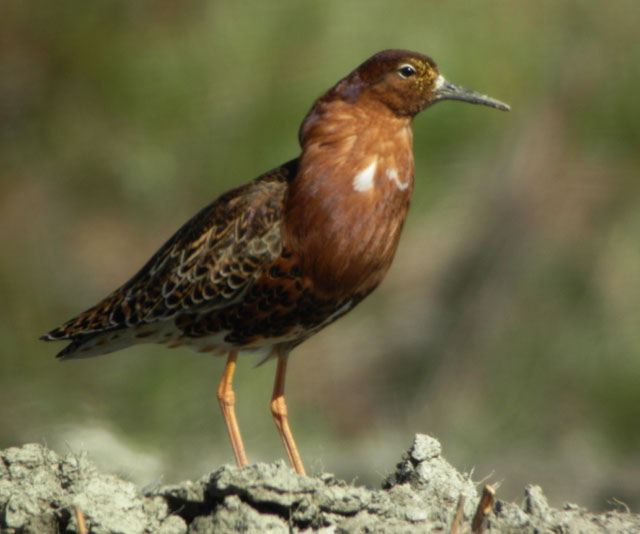
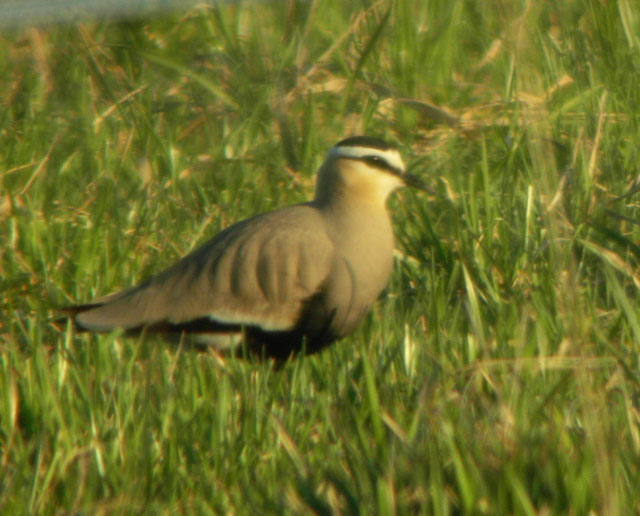
On the 30th of May we were ready to leave again towards Tampere at 6:15 a.m. We had planned only one stop on the way which was made in Lappeenranta Joutseno Kotasaari. After walking 1.5 kilometres from the main road to the pools, we found first 2 Little Ringed Plovers and after some searching also 11 Broad-billed Sandpipers! So David had got a lifer for each day of the trip!
At midday we were in Tampere where we got my car from the garage and continued towards Pirkkala airport. After seeing 167 species, including all target owls, woodpeckers, grouses, Red-flanked Bluetail, Siberian Tit, Siberian Jay, Great Snipes, Blyth’s Reed Warblers, Thrush Nightingales, Pallid Harrier and much more in a week it was time say goodbye to the group. Only target species that we had missed were Little Bunting, Arctic Warbler and Red-necked Phalarope – the 2 first ones hadn’t been seen in whole country yet and the last one I didn’t know any place where to see it easily without wellingtons – thanks to Ryan Air the group didn’t have them. So it wasn’t a surprise that at least some of the group said that this had been the best birding trip they had ever done – and these guys had been travelling a lot!
But after all, I had still a long holiday to do birding! And staying in Tampere wasn’t a part of my plan – so I hit the road again!
J.A.