Finally a self-found Finnish-tick
This was my first late autumn in 9 years that I wasn’t going abroad for birding. I had been birding quite a lot and I started to feel that I had seen too many Barnacle Geese, I really needed something different. So I booked myself in to Luvia Säppi birding station for the weekend.
I was a long drive and I had to hurry to make it to Pori on Friday the 8th of October and catch the ferry at 6:30 p.m. On the harbor I met Petteri Mäkelä, Juha Sjöholm and Pasi Alanko who were going to stay on the island for longer and Matti Mäkelä, Teppo Lehtola and Sebastian Andrejef who were going to stay only for the weekend.
We carried our luggage to the boat and soon left to Säppi where we were about 30 minutes later. It was already getting dark, so we just carried our things to the station and started to plan which birds we were going to find on the next day. . Petteri mentioned a Booted Warbler which has never been seen in Satakunta, but I was hoping for anything else… On the station we met also Kari Mäntylä, who had been ringing on the station for a week already
On the 8th of October we woke up before 7 a.m. and after breakfast and wearing lots of clothes, we walked to do the morning migration watch, which starts at sunrise and lasts for 2 hours. It was quiet on the sea, just some flocks of Common Scoters, some Long-tailed Ducks, Velvet Scoters, Common Eiders, a big flock of Barnacle Goose looking geese (I was happy they were too far), 8 Razorbills, a couple of Red-throated Divers and a Brent Goose. Lots of corvids and passerines were also migrating and they included 3 Rooks, lots of tits and quite a few flocks of Parrot Crossbills and Bullfinches. Best local birds were 3 Purple Sandpipers, 3 Lapwings, 2 Black Guillemots and a Grey Heron.

Afer 2 hours we left to walk around the island. There were lots of tits and even Long-tailed Tits, Goldcrest and Chiffchaffs feeding on the ground and after some time we found a Yellow-browed Warbler. Later we still found some Dunnocks, Wren, Blackcaps and a Common Redstart.
Finally we arrived to Prakala where we once again started to check every single bush very carefully. While some of us were walking almost through the bushes others were on the both side watching if there are any birds moving. Once again one bird was moving in front of Pasi and Petteri managed to it first and immediately noticed there was something strange in it. The bird disappeared too soon and Petteri told me to watch to the bush where he had seen it. And then the bird flushed again and we could see it flying to the next bush. We could see a strange way of flying with almost hanging tail and the coloration which was pale sandy brown. We both immediately said: “It is an Iduna warbler”. I even continued that: “It wasn’t a Booted Warbler”.
We shouted to the others and soon were checking the bush where we had seen the bird landing and soon found it again. Pasi managed to get a couple of pictures of it and even though I managed to see it only very briefly, I could say that this bird was not a Syke’s Warbler. Then we checked Pasi’s pictures and we could easily see that it was an Olivaceous Warbler! We had found the 6th Olivaceous Warbler for Finland!
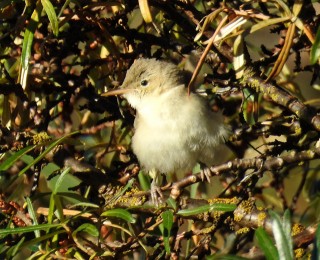
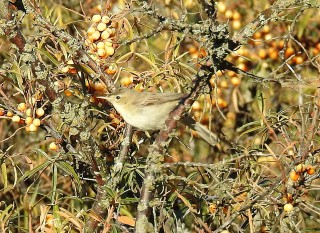
We put a mist-net up and tried to catch the bird but very soon gave up and decided not to disturb it anymore. I had also managed to get some really good pictures and we had all seen the bird extremely well. The bird had also started to call pretty much and it was lowering it’s tail a lot.

We know that there was the first group of twitchers coming after 1.5 hours, so we left the bird and went to check a couple of other places. We found another Yellow-browed Warbler but soon walked back to Prakala just when the boat was arriving to harbor. When we were closing to the bushes, we could already hear the bird calling and soon the whole group of mostly local twitchers saw the bird too.
When the twitchers left we walked back to the station and counted the birds we had seen during the day. We had seen 73 species and some of the best numbers were 200 Goldcrests, 402 Long-tailed Tits, 335 Great Tits, 250 Blue Tits, 288 Redpolls, 178 Parrot Crossbills and 351 Bullfinches.
The rest of the evening we were celebrating! But after all we were all thinking that after we had found the Olivaceous Warbler, we hadn’t had time to check some of the best areas of the island and there were more rarities to find. So we went to sleep surprisingly earl.
On the 9th of October we woke up before 7 again and this time we went to do the morning migration-watch to Prakala. There were 7 boats of twitchers coming so we wanted to see if the bird was still there and the twitching was going smoothly.
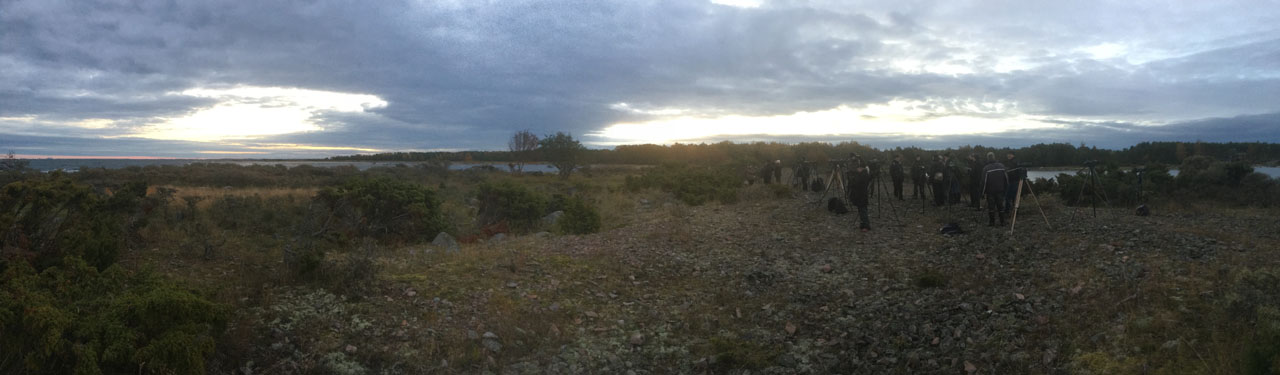
The first group of twitchers was already in Prakala when we got there and luckily soon the bird was calling and also seen very well again. Even Pekka Komi got a lifer and he is now number 1 twitcher in Finland. Most of the other top-10 twitchers had seen the only twitchable bird in Lemland Lågskär in 1996.
There was again quiet on the sea but even more tits and Parrot Crossbills were on the move. The Olivaceous Warbler stayed well visible until a couple of photographers pushed it almost to the sea and then we had to shout them to get further from the bird. And soon the bird was again on the same bushes where it had been almost all the time. One Purple Sandpiper was on the islet again and all the twitchers managed to see it too.
Soon arrived the second boat full of twitchers and after 9 a.m. the third. Everyone saw the bird easily, so we continued to walk around the island again. We decided to go to the places where we hadn’t been at all on the previous day.
But we didn’t find much. Tits and Parrot Crossbills were on the sky all the time but only better birds we saw were a Grey Plover, 3 Blackcaps and 2 Arctic Redpolls. After all during the whole day 305 Long-tailed, 14 Willow, 21 Coal, 1106 Blue and 237 Great Tits, 165 Bullfinches and even 508 Parrot Crossbills were seen!
After all we were back in harbor and we weekend visitors had to go to pack our things. At 3 p.m. we said goodbye to the friends who still stayed on the island and left back towards Pori by boat which had just arrived with the last and 7th group of twitchers.
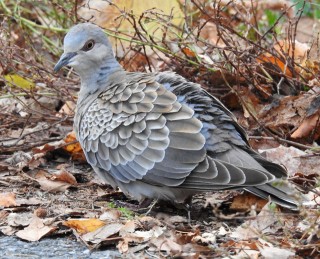
Sampsa Cairenius was coming with me so I didn’t have to drive alone. In Pirkkala we twitched a tame Turtle Dove that we could photograph from 2 meters. I dropped Sampsa to Joutseno and finally after 10 p.m. I was back in Parikkala.

It had been really amazing weekend in Säppi! And I had got exactly what I had wanted – amazing self-found lifer! This was also the 300th story on this caligata blog – maybe I should change the name to pallida?
And Olivaceous Warbler stayed in Säppi until Tuesday evening. Then it was also caught and ringed. On Wednesday morning it wasn’t found anymore. I wonder where it continued?
J.A.