Spring-trip to Jurmo
On the 5th of May after finishing duck-counts in Saari, I packed our car and started a long drive. It started to rain soon so after all I drove until Turku where I did some shopping and then continued along Saaristotie. It was already dark when crossed by ferry to Nauvo and there I drove to the same place where I had been tenting last autumn. Now I had to sleep in a car.
On the 6th of May I woke up early and drove to Nauvo to do the last shopping. Then I dropped my big bags to Baldur ferry, parked my car to a big parking place close to the shops and then walked to the ferry with my optics. The ferry was now leaving from Nauvo as Pärnäinen harbor was under construction.
It was still raining so I went to sit inside the ferry, but pretty soon the weather cleared and I climbed to the deck where a couple of birders were already. A couple of Arctic Skuas, 10 Black Guillemots and 12 Razorbills were seen before I decided to go to eat to the restaurant. And soon Jurmo was visible in the horizon.
Once I got to Jurmo I tried to find milk-wagons but there were none. Then I started to think if I had arrived in right time and day. I called to one man that was in the ringing station and they hadn’t expected me to come yet. I had come one day too early! So I carried my optics a long way to the station, took wagons and walked back to the harbor to pick up the rest of bags.
While walking I already got many year-ticks: Common Redstart, Whinchat, Pied Flycatcher, Blackcap, Lesser Whitethroat and Wryneck. Most of these species had arrived to the island today but now there were plenty of them.
There were already 7 people on the station so it was full. But I left my bags outside and took my place from sauna. Luckily I knew all the people and they knew that I didn’t need too much space. And anyway 3 of them were leaving at 5 a.m. on the next morning.
I still had time to go to do some birding so I walked first to Sorgen and then inside the forests and managed to see a Hen Harrier, a Hobby, some Common Shelducks and even a Little Tern. During the day there had been several Ring Ouzels, a Black Redstart and even 2 Avocets had been seen flying over the island but it seemed that most of the birds had moved on.

On the 7th of May we woke up very early and Jussi and Pekka Virtanen and Kari Tuominen were leaving. Kim Kuntze and Meri Öhman left to put up the mist-nets and together with Vesa Virtanen and Timo Palomäki we left to do morning migration watching which is done every morning for 2 hours.
Like usual there weren’t much migration but some Common Eiders, Common and Velvet Scotersm Long-tailed Ducks, Black-throated and a few Red-throated Divers, Razorbills and a Black Guillemot and so on were seen. We managed to see a flock of Purple Sandpipers far on the western tip of the island which was a new May-tick for me. It was very cold and I hadn’t go time to organize my thngs yet so I didn’t have enough clothes. So after 2 hours I hurried to the station to eat warm breakfast.
The day continued with station routines so Timo and Vesa did counts in east I went to count birds in west. And the rest of the trip I did every second day west and east counts. My count started well with a Little Tern and a Turnstone and then I found a couple of Purple Sandpipers and managed to get quite good pictures of another bird. From the pictures I realized that it had a flag and soon I got information that it had been ringed here in Jurmo a couple of years earlier.
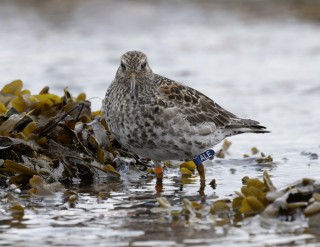
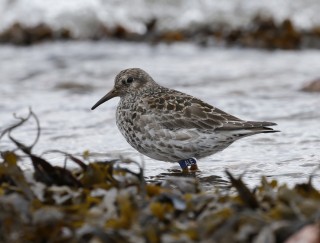
Other birds seen were a couple of Common Shelducks, common ducks, Oystercatchers, a Curlew, a Bar-tailed Godwit, Common Redshanks, Common and Arctic Terns, gulls, a Yellow Wagtail as a year-tick and so on. In the afternoon Petri Puolakka arrived as the second ringer – he came by the ferry that I was supposed to arrive too.
 In the afternoon and evening I walked around the island and photographed a couple of Rock Pipits but as I found nothing interesting I went to tick a Water Rail that had been calling on the bog for some days already.

On the 8th of May we started from the hill and did migration watching again. But no I was wearing almost all clothes I had with me. We saw quite good geese migration with some flocks of White-fronted Geese, a single Bean Goose and of course Barnacle Geese which I really didn’t care to see… Other birders were happy with the geese but I was much more interested to see a collybita Chiffchaff that Kim caught from the mist-net. It was good to study and photograph this subspecies which seems to be much more common in southern Finland that has been thought.

The walk in east was productive even though there were quite a few tourists walking on the shore. I managed to find a stunning male Ring Ouzel and a male Black Redstart too. But they were both too shy to get almost any pictures.
Other birds during the day were a Gadwall, a Smew, an Osprey, 25 Whimbrels, a Turnstone, a couple of Little Terns, Rock Pipits and 2 more Black Redstarts in the harbor. Before the log in the evening we still saw a Common Whitethroat from the window. The log was long again and it was very late when we went to sleep. And then Petri came from the mist-nets with a couple of Mallards! Of course we had to see these rare mist-net birds – and then the alarms were on again about at 4 a.m.
On the 9th of May morning I went to help Petri to bog mist-nets. Finally the wind was south-western, so there were quite a few Song Thrushes, Robins (still too many Robins, altogether 348 ringed), a Tree Pipit, Common Redstarts, Blackcaps, some Lesser Whitethroats, Chiffchaffs, Willow Warblers, a Pied Flycatcher, a Goldcrest and a Thrush Nightingale and so on. Best birds were a Swedish and a Swiss Robin)
I climbed a couple of times to the hill to see migration and once I was there on the right time as an amazing flock of 270 Song Thrushes rose from the pine-forest to the sky.
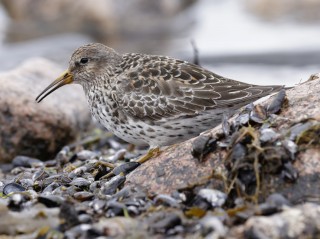
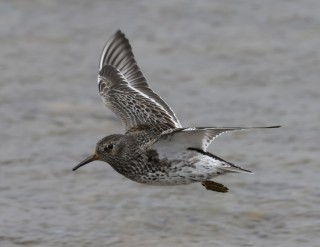
In west I was on the south-western tip counting the birds that were outside the counting area when a flock of Purple Sandpipers landed to the shore. I tried to get close with my camera but they were moving a little bit further. I still decided to try another part of the flock and surprisingly they didn’t care at all. So after all I was laying down just 2 meters from the actively feeding birds. It was amazing! Birds were also calling actively and I did my best even though I still haven’t got time to study my camera almost at all.
Again I managed to get pictures of birds with flags too so it will be interesting to hear where are they from. After a half of an hour photographing I had to continue my count and I slowly moved further from the birds that still didn’t care at all.
On the lake I saw 12 Dunlins and after the count I heard calls of a Little Ringed Plover. Other birds during the day were a couple of Short-eared Owls and several Rock Pipits. In the evening Petri went to the west with a net and a flashlight and managed to caught some birds which a Teal and a Common Ringed Plover were the most interesting ones.
On the 10th of May it should have been rainy in the morning so almost everyone was sleeping. But I have used to check the weather in case and again the weather forecast had been wrong. I woke up the ringers and Petri hadn’t been slept for long. Anyway we agreed that I go to open mist-nets to pine forest for him. But Kim and Meri had made a decision to go west to search for rarities. I immediately thought this wasn’t clever as the weather looked perfect for passerines and it would have been good to have all possible nets open.
 And the morning was extremely busy indeed! There were amazing numbers of Blackcaps and Common Redstarts and many other passerines too. Pied Flycathers, Whinchats, Lesser Whitethroats, Song Thrushes, a Mistle Thrush, a few Wood Warblers, Chiffchaffs, Willow Warblers, a Red-breasted Flycatcher, a Sedge Warbler and so on. If all the mist-nets would have been open, many records would have been crushed. A couple of showers made us hurry even more but luckily it wasn’t raining too much. A couple of Ring Ouzels were seen while being busy.
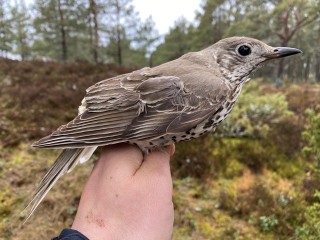
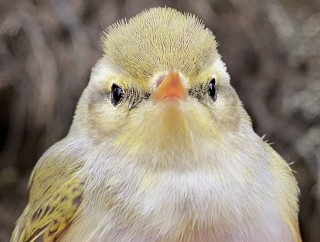
There were amazing numbers of birds in the whole island. New arrivals that I also managed to see or hear were a Swift and a Cuckoo. Finally Kim and Meri arrived from west and kept on helping Petri. So I was free to go to east again and there I managed to find a male Garganey, a Jack Snipe, a couple of Turnstones and a few Rock Pipits. I also saw a Hawfinch and in the evening there seemed to be Blackcaps and Common Redstarts everywhere!
On the log we made careful counts and the numbers were amazing: 11 Wrynecks, 224 Common Redstarts (68 ringed), 109 Whinchats, 74 Northern Wheatears, 97 Lesser Whitethroats (33), 21 Common Whitethroats, 488 Blackcaps (176), 88 Chifchaffs (44), 31 Willow Warblers and 93 Pied Flycatchers (63 + a Swedish control). With 2 or 3 ringers and all nets all the numbers would have been easily doubled! Also 3 foreign controls were caught: a Russian Robin, an Italian Common Redstart and a Swedish Pied Flycatcher.


And with good migration in the morning too we found out that we had made a record in daily species too as we had seen altogether 122 species during the day! And only rarer bird had been a Great Snipe that Timo and Vesa had seen.
On the 11th day we headed to the bog with Petri while Kim and Meri went to the forest. It was surprisingly quiet and but some better birds were caught like 2 collybita Chiffchaffs, 2 Thrush Nightingales and a Grasshopper Warbler. And finally Kim called that he had caught a beautiful male Collared Flycatcher – it was the species that I had been hoping most! Petri got the flycatcher to his ringing list and then a lot of pictures were taken of course. Later I went to photograph also an Icterine Warbler that was caught.
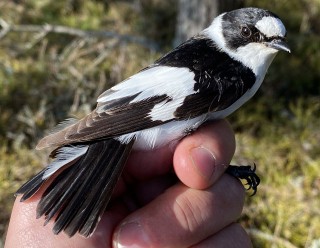
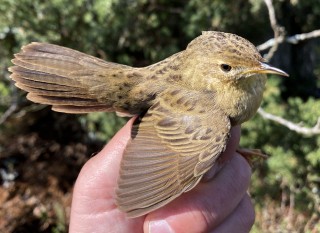
Finally we left Kim and Meri to check all the nets and left west with Petri. It was very quiet day overall, but we saw some distant Purple Sandpipers, a Bluethroat briefly and then a very strange-looking leucistic Lesser Whitethroat which was one of 109 Lesser Whitethroats of the day!
A couple of Black Redstarts were seen in our garden and a male Red-backed Shrike was seen briefly too. In Sorgen I found probably the same Ortolan Bunting that Vesa and Timo had seen in east and Spotted Flycatchers had arrived. After the log a Nightjar was caught which is always nice.
On the 12th day we were in the forest with Petri and Kim and Meri on the bog. It was very warm morning and it started nicely with a Reed Warbler. But soon it was so quiet that I had to find out something else to do as Petri didn’t need help. So I climbed to migration watch with Timo and Vesa and soon Kim called that he had found another male Collared Flycatcher. It was on the southern forest and we could see it with our telescopes from where we stood. The bird was catching insects on the top of alders. Later I tried to get pictures of this bird but it was too high up on the trees.


In the afternoon Jari Helstola and Ohto Oksanen arrived and Petri left. Ohto put up many new mist-nets around the island and Jari is one of the hardest working birders I have ever met, so the expectations were high that something better will be found soon.

In the evening I went east again and found another Black Redstart and now there were a couple of Garganeys. A couple of Bluethroats were seen in the garden with another Black Redstart. A Reed Warbler was singing next to the pasture and Garden Warblers had arrived, even 22 birds were counted altogether (10 ringed). Altogether 4 Red-breasted Flycathers had been found and a male Collared Flycatcher was found in the pine forest, but it was maybe the same as in the morning. Also the same Ortolan Bunting was still around.
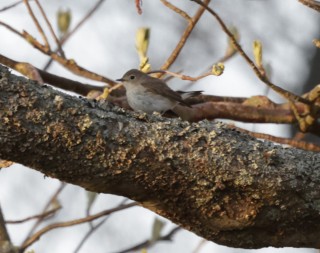 On the 13th of May I went to migration watching with Vesa and Timo. It was quiet but the “Hessu” called that some birders were watching a possible Pied Wagtail somewhere on the moor. We saw the birders and almost immediately saw a good-looking “yarrellii” in front of them. I ran to get my camera from the station but of course the bird was long gone already. But these birders had got really good pictures and it really looked good for a young male Pied Wagtail. I went to search it from Sorgen but saw only a Gadwall and a Red-breasted Flycatcher. I soon climbed to the hill again and we kept on watching migration which almost wasn’t at all, but then Vesa said: “There is something interesting on the track”. I found the bird soon and immediately said: “It’s a female Siberian Stonechat or Stonechat!” And then the bird flight and showed its creamy-white rump without stripes and it was easy t identify as a Siberian Stonechat.
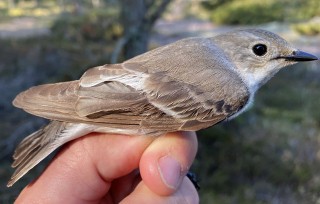
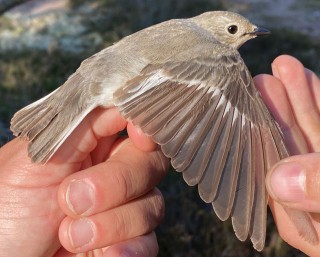
The Siberian Stonechat was extremely mobile so I could get close to get any good pictures but luckily it stayed on the open area for so long time that everyone managed to see it before it disappeared. Then I still stayed on the hills for some time and found 4 migrating Caspian Terns. And while I was walking to the station I heard calls of a Collared Flycather close to the last mist-nets but couldn’t find the bird. And once I was in the station, Kim called that there was a female Collared Flycatcher on the mist-net exactly where I had heard the calls. It was good to get a possibility to study a female flycatcher well.
During the day I did western count again and it was very good. Little Terns were seen at least 4, amazing flock of 350 Purple Sandpipers were flying on the islets and finally I saw the local pair of “schinzii” Dunlins and even managed to get good pictures of them. Also a Temminck’s Stint was seen and a couple of Ruffs. While I was walking back I found probably the same Siberian Stonechat but it disappeared almost immediately. Other goodies during the day were a Marsh Harrier, a Black Redstart and altogether 5 Red-breasted Flycatchers.

In the evening Kim and Meri had ordered berry-pie from the hotel to celebrate Siberian Stonechat that had been a Jurmo-tick to everyone else except Timo and Ohto, even to “Hessu” who is the leader in Jurmo-ticks.
On the 14th of May we woke up early and we had packed everything already with Vesa. Then we did a short walk near the church and heard a Common Rosefinch as a year-tick. Soon we had to start walkimg towards harbor.

On the ferry we climbed to the deck where a couple of birders coming from Utö were already. We didn’t see many birds but before Nötö Vesa found a couple of alcids and immediately I realized that they were different in size and shape. With scope it was easy to see that one was a Razorbill but another one was a Common Guillemot. These birds were flying towards Jurmo, so we called to “Hessu” and surprisingly they managed to see these birds but from very big distance.
We also saw a Grey Heron, a Black Guillemot and a dozen of Slavonian Grebes. Finally we arrived at Nauvo where we carried our bags to our car and started driving. I dropped Vesa to Kaarina and continued alone.
I had been sleeping very badly on the previous night and overall I hadn’t got enough sleep as days are extremely long in Jurmo. So I decided to do some twitching on the way. There had been a Montagu’s Harrier and a Mandarin Duck in Vantaa, but once I got near the harrier was gone already. So I tried to find Mandarin Duck in a couple of places but wasn’t lucky. It was very hot day, so I started to feel that my long underwear was too much…
There had been a Hoopoe in Porvoo, so I continued next to Bosgård where I met a few birders who hadn’t found the bird. I kept on searching for it for an hour and already gave up once but still decided to come back after I had driving accidently towards wrong direction and I had to drive past the place again. Then I was lucky and saw a Hoopoe flying high over me.
I had planned to go to Virolahti for the next morning but there had been so many good birds in Parikkala that I decided to drive home after all. I still made a stop in Joutseno Kotasaari where together with Sampsa we heard 3 Great Reed Warblers, a Wryneck, saw 3 Sand Martins and a Little Ringed Plover but nothing better than those.
Finally I was in Parikkala where I still went to listen to a Nightjar in Sounio and a Spotted Crake in Siikalahti. Finally I was at home and I was extremely tired but happy – the trip to Jurmo had been excellent!
J.A.